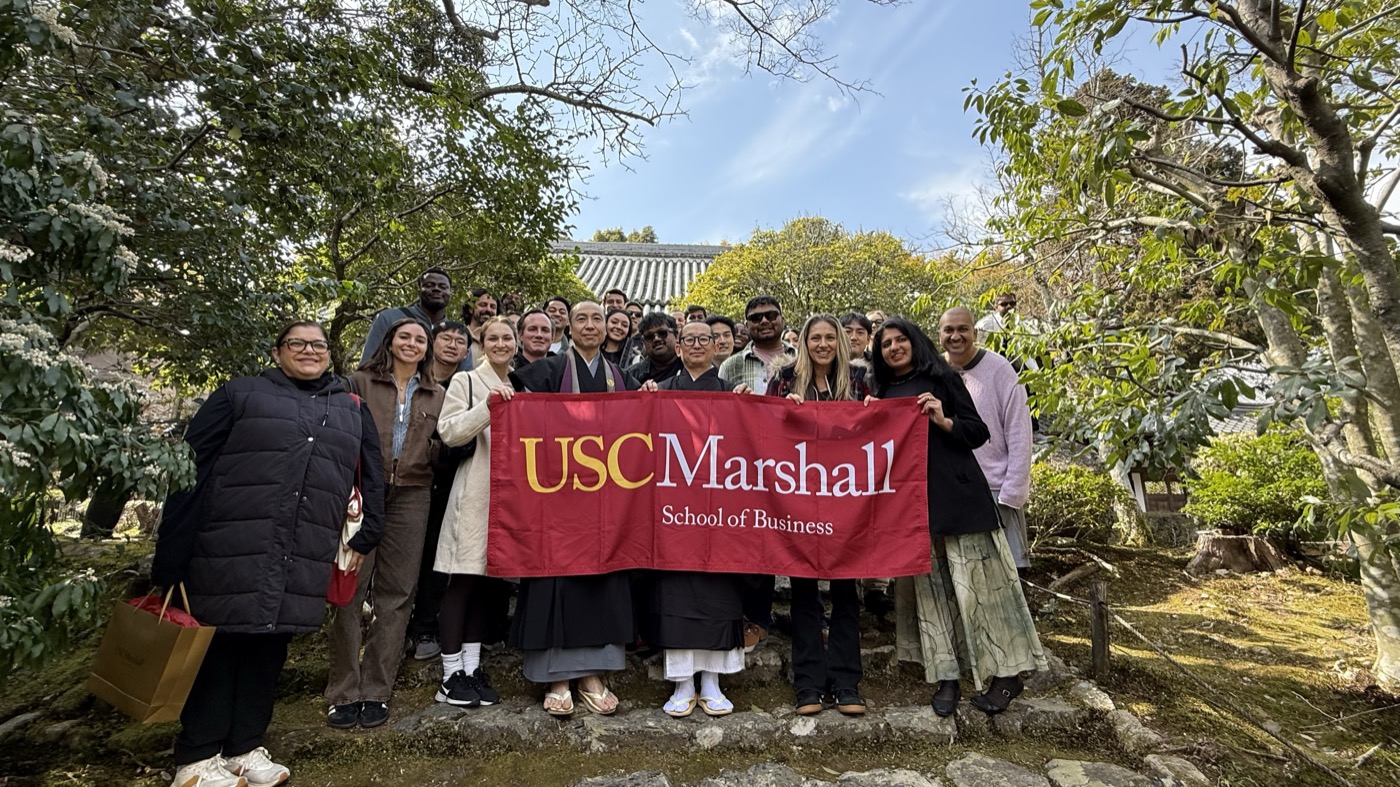
USC Marshall School of Business
Hosting USC Marshall MBA Students in Kyoto
March 20, 2026
In March 2026, KMC had the privilege of hosting a cohort from USC Marshall School of Business — one of the leading MBA programs in the United States — for an Executive Session at a historic Kyoto temple.
The session
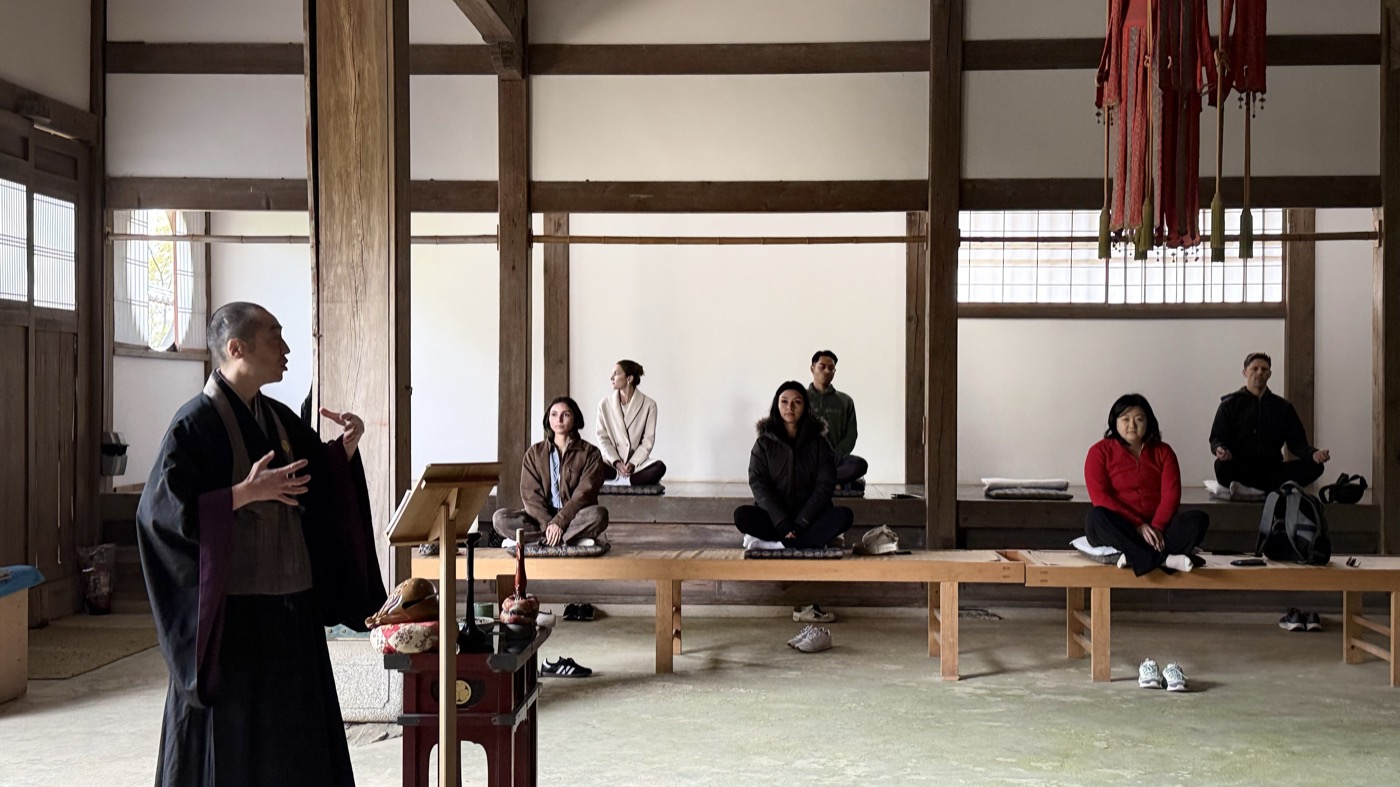
The group joined us for a full Executive Session: beginning with the historical context of how Japan’s contemplative practices developed specifically for leaders under conditions of extreme uncertainty, moving into seated practice, and closing with discussion on application.
A particular focus of the day was how the five-senses framework — the foundation of our Instant Clarity practice — can be embedded into everyday professional life, without requiring a trip to Kyoto or a retreat. The students engaged seriously with this question: how do you carry a practice into a role that leaves little room for anything that doesn’t move fast?
The startup conversation
Beyond the practice itself, the session included an open exchange about KMC as an organization. We shared what it looks like to build a company at the intersection of a thousand-year tradition and a modern global market — the challenges of credibility, of scale, of translating something genuinely cultural into a format that doesn’t lose what makes it worth translating.
The students brought sharp questions. Several had firsthand experience with the conditions the practice addresses — high-stakes decisions, performance pressure, the gradual erosion of clarity that comes with sustained uncertainty. That directness made for one of the more substantive discussions we have had.
On working with MBA programs
KMC has partnered with several MBA and executive education programs over the past years. What consistently strikes us is the gap between the sophistication of business training and the near-absence of any framework for the internal dimension of leadership — the quality of attention, judgment, and self-observation that no case study can fully develop.
We believe that gap is exactly what this practice is built to address. We are grateful to the USC Marshall team for making this visit possible, and look forward to continuing the conversation.